
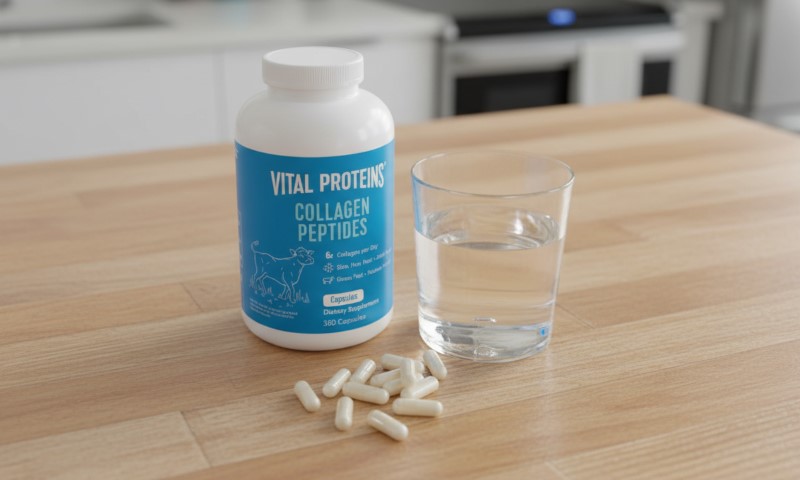
Collagen sits at the center of modern beauty and wellness marketing for a simple reason. It is a structural protein that gives skin firmness, joints resilience, and connective tissues their strength.
Inside the human body, collagen accounts for about 30% of total protein. No other protein plays a broader structural role.
Interest in collagen supplements keeps growing, yet the important question stays the same. Does swallowing collagen in pill or powder form reliably change skin, joints, or connective tissue, and what actually supports the body’s own collagen production in ways that hold up beyond advertising claims?
The answer lives somewhere between hype and dismissal. Research shows signals worth paying attention to, alongside clear limits. Context matters. Biology matters. Expectations matter.
What Collagen Really Is, And Why Type Matters

Collagen is not a single substance. It is a family of proteins with distinct structures and functions, distributed across tissues depending on mechanical demands.
The Main Collagen Types Found In Supplements
Supplement labels often highlight multiple types because the collagen source shapes the profile. Marine collagen products tend to emphasize Type I. Cartilage-derived products focus on Type II. The label reflects origin and processing more than targeted delivery inside the body. Marketing language often suggests collagen travels from a drink or capsule directly into skin, hair, nails, or joints. Human digestion does not work that way. All dietary protein is broken down into amino acids and small peptides before absorption. Collagen behaves no differently. After ingestion of hydrolyzed collagen, researchers have measured hydroxyproline-containing peptides in human blood. That finding confirms collagen-derived fragments enter circulation. It does not prove direct placement into skin or cartilage. A more realistic interpretation fits basic physiology. Collagen supplements provide a specific pattern of amino acids and small peptides. Those fragments may serve as building material and may also offer signaling cues that influence connective tissue turnover. That pathway remains indirect and variable. Not all collagen products function the same way. Form influences digestion, absorption, and research relevance. Hydrolyzed collagen dominates the market. Processing breaks the protein into smaller peptides, improving solubility and digestion. Most clinical trials evaluating skin hydration, elasticity, and joint symptoms rely on hydrolyzed collagen. Gelatin is cooked collagen, widely used in food. It offers nutritional protein value, yet modern clinical research related to skin and joint outcomes centers on hydrolyzed collagen peptides rather than standard gelatin. Undenatured Type II collagen remains structurally intact. Research suggests it may work through immune-mediated oral tolerance rather than by serving as raw building material. Several studies use 40 mg daily dosing and report improvements in joint-related outcomes. Skin outcomes represent the most widely studied application, with hydration and elasticity showing the strongest support. Changes in wrinkles tell a more restrained story. A 2023 review of oral collagen and skin anti-aging outcomes reported improvements such as increased skin hydration across included trials. A 2025 meta-analysis covering 23 randomized controlled trials with 1,474 participants reported statistically significant improvements in hydration, elasticity, and wrinkles overall. A critical detail followed. Subgroup analysis showed trials without pharmaceutical-company funding did not demonstrate the same effects. Funding bias shapes interpretation. Nutrition and health guidance from Harvard University maintains a cautious stance. Evidence suggests potential benefits for skin elasticity and hydration, yet research quality, independence, and scale remain limitations. Skin-related effects, when present, appear modest and gradual. Joint health research focuses heavily on knee osteoarthritis, a condition affecting over 32.5 million adults in the U.S. The burden makes symptom-focused interventions valuable. A 2023 meta-analysis reported significant pain relief among knee osteoarthritis patients using collagen peptides compared with placebo. Limitations and potential bias were also noted. A 2025 systematic review and meta-analysis evaluating collagen-based supplements for knee osteoarthritis reflects a growing evidence base, though outcomes vary by product type, dose, and study design. UC-II follows a separate research track. A PubMed study in healthy subjects reported improved knee joint extension with 40 mg daily supplementation. Later trials and reviews discuss efficacy and safety in osteoarthritis contexts, often using the same daily dose. Collagen supplementation appears most plausible as: Severe pain, swelling, instability, locking, or trauma call for a structured medical evaluation rather than supplement experimentation. Athletic marketing often frames collagen as a recovery shortcut. Research paints a narrower picture. A 2024 systematic review and meta-analysis described collagen peptide supplementation as a promising adjunct to physical training for musculoskeletal performance in adults. Authors emphasized the need for further research on mechanisms and tendon outcomes. A 2025 randomized controlled trial published in Medicine & Science in Sports & Exercise reported improvements in muscle-tendon stiffness and explosive strength over 16 weeks. Physiology offers important context. Resistance exercise itself stimulates collagen synthesis in muscle and tendon tissue. Progressive loading remains the dominant signal driving adaptation. Collagen supplementation may offer incremental support in specific contexts. It does not replace adequate total protein intake, structured training, or recovery. Hair and nails attract attention because marketing promises visible outcomes. Independent, large-scale trials remain limited. Nutrition commentary from Harvard Health Publishing repeatedly notes the lack of clear proof that oral collagen directly improves hair thickness or nail strength in a predictable way. Amino acid availability supports keratin production indirectly, yet claims often exceed evidence. Effectiveness cannot be separated from product quality. Supplements vary widely in content, contamination risk, and labeling accuracy. The U.S. Food and Drug Administration explains that dietary supplements are regulated differently from drugs. Manufacturers hold responsibility for ensuring products are not adulterated or misbranded before marketing. Third-party certification programs offer additional protection. NSF International describes independent audits and ongoing testing for certified products. A peer-reviewed overview in the Journal of the Academy of Nutrition and Dietetics reviews certification frameworks such as USP and NSF. No supplement can override basic biology. Supporting collagen synthesis and limiting unnecessary breakdown delivers the greatest return. Vitamin C plays a direct role in collagen biosynthesis. Severe deficiency impairs collagen formation and leads to connective tissue problems such as poor wound healing and bleeding, classically observed in scurvy. Nutrition guidance from Harvard T.H. Chan School of Public Health lists citrus fruits, berries, leafy greens, bell peppers, and tomatoes as rich sources. Low vitamin C intake undermines any collagen-focused strategy. Collagen is built from amino acids. Nutrition research highlights the role of glycine, proline, lysine, and zinc in collagen synthesis and connective tissue turnover. Aging skin shows reduced collagen synthesis linked to altered fibroblast activity and mechanical signaling. Resistance training provides mechanical input that supports connective tissue remodeling. Exercise-based stimulation of collagen synthesis carries broader benefits that supplements cannot replicate. Ultraviolet radiation damages extracellular matrix components such as collagen and elastin. The U.S. Food and Drug Administration describes how unprotected UV exposure contributes to premature wrinkling and texture changes. Daily sun protection represents one of the strongest collagen-preservation strategies available. A classic PubMed study found smoking reduces synthesis rates of Type I and Type III collagen in skin while increasing degradation. Dermatology literature also documents increased matrix metalloproteinase activity among smokers. Spending money on collagen supplements while smoking reflects misplaced priorities. Advanced glycation end products accumulate on collagen over time, contributing to stiffness and loss of elasticity. A 2024 review describes how high-sugar and heavily processed diets increase systemic AGE formation. Lowering added sugar intake supports long-term collagen quality even without marketing appeal. Collagen supplements are neither miracle cures nor useless by default. Context determines value. Strong collagen outcomes rely on consistent habits rather than novelty. Collagen matters deeply to human structure and resilience. Supplements show potential in specific, limited contexts, particularly for skin hydration and joint discomfort. Expectations deserve restraint. The most powerful levers supporting collagen production remain nutritional adequacy, mechanical loading, sun protection, and lifestyle choices. Pills may assist around the edges. Foundations determine outcomes.
A Key Biological Reality: Collagen Is Not Absorbed As Collagen
Collagen Supplements By Form
Hydrolyzed Collagen (Collagen Peptides)
Gelatin
Undenatured Type II Collagen (Often Marketed As UC-II)
Do Collagen Pills Work For Skin
What Reviews And Meta-Analyses Report
What That Means In Practical Terms
Do Collagen Pills Work For Joints And Arthritis
Collagen Peptides And Knee Osteoarthritis
Undenatured Type II Collagen For Joint Support
Practical Interpretation For Joint Health
Collagen For Muscle, Tendons, And Training Adaptations
Hair And Nails: High Expectations, Thin Evidence
Safety And Supplement Quality Matter
Practical Quality Guidelines
What Actually Boosts Natural Collagen Production
Vitamin C Remains Essential
Adequate Protein Intake Sets The Foundation
Mechanical Loading Through Strength Training
Sun Exposure Accelerates Collagen Breakdown
Smoking Disrupts Collagen Balance
Sugar Intake And Collagen Glycation
A Realistic Decision Framework

Evidence Snapshot
Goal Area
Evidence Summary
Typical Study Duration
Confidence Level
Skin hydration and elasticity
Often improves modestly, funding bias present
8 to 12 weeks
Moderate
Wrinkles
Mixed results, limited visible impact
8 to 12 weeks
Low to moderate
Knee osteoarthritis pain
Symptom relief versus placebo reported
12+ weeks
Moderate
UC-II joint support
Symptom improvement with 40 mg daily
90 days and beyond
Moderate
Tendons and training
Promising adjunct data
12 to 16 weeks
Emerging
A Practical Collagen-Support Plan Without Pills
Final Perspective